
Our Blog
Discover insights, innovations, and industry knowledge from our experts.
Camel Milk and Crohn’s Disease Management: Modulating Gut Inflammation & Microbiota
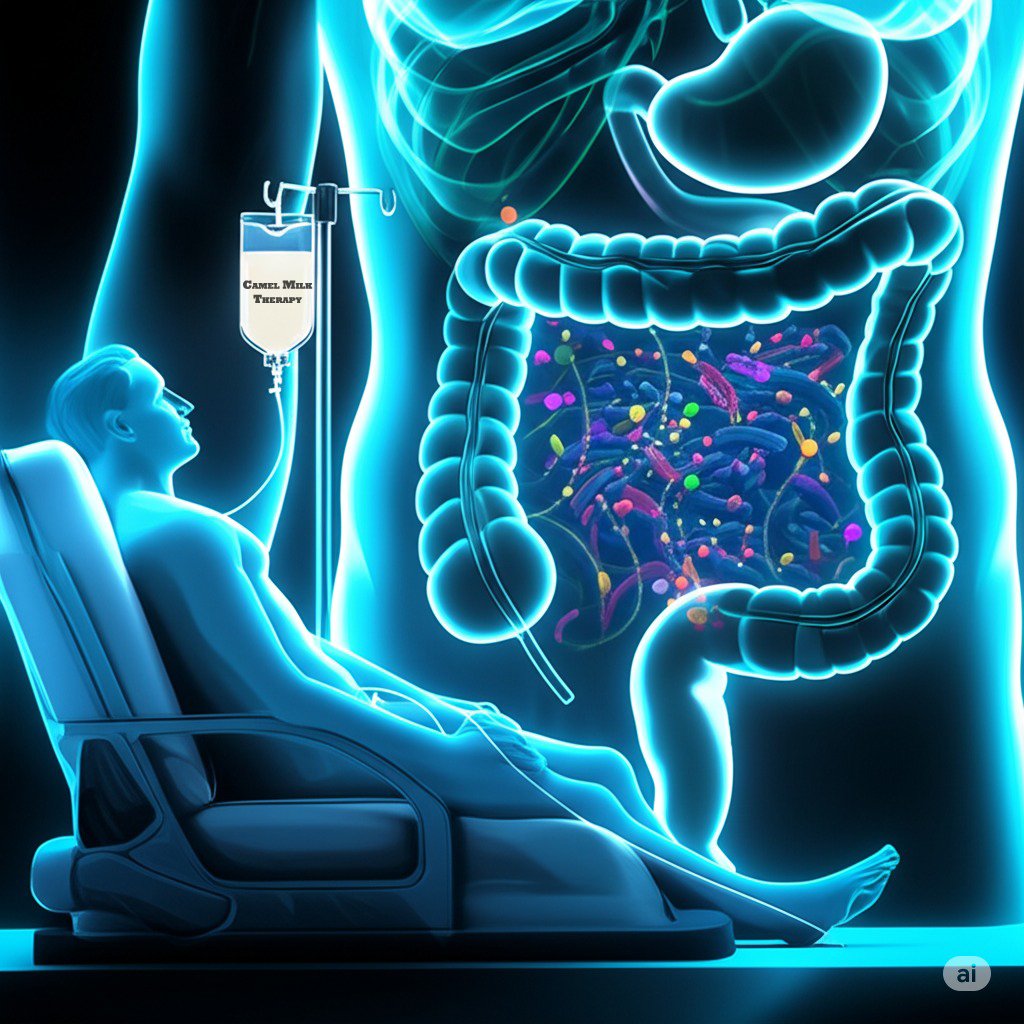
Crohn’s Disease (CD), a chronic inflammatory bowel disease (IBD) characterized by transmural inflammation and immune dysregulation, presents significant management challenges. Conventional treatments often focus on immunosuppression but may carry substantial side effects and limited efficacy in some patients. This has spurred interest in complementary dietary approaches, with camel milk (CM) emerging as a promising candidate due to its unique biochemical composition and multifaceted biological activities. Emerging research suggests CM may modulate key pathological processes in CD, including gut inflammation, immune dysfunction, microbial dysbiosis, and impaired nutrient absorption.
The potent anti-inflammatory properties of CM constitute a primary mechanism for its potential benefits in CD. CM contains a rich array of bioactive components, including lactoferrin, immunoglobulins, and vitamin C, which collectively target inflammatory pathways. In murine models of colitis (a condition sharing inflammatory features with CD), CM administration significantly reduced levels of pro-inflammatory cytokines like IL-6, IL-1β, and TNF-α. This effect is partly attributed to CM’s ability to enhance intestinal barrier integrity. Research demonstrates CM promotes the expression of tight junction proteins (claudin-1, occludin, and zonula occludens-1), thereby restoring the physical barrier that prevents bacterial translocation and subsequent immune activation. Furthermore, specific proteins within the camel milk fat globule membrane (MFGMP) have been shown to downregulate the Wnt/β-catenin signalling pathway, a pathway implicated in inflammatory processes and epithelial cell repair in IBD. This reduction in inflammation is clinically relevant, as evidenced by studies showing CM prevents colon shortening, reduces disease activity index scores, and attenuates histological tissue damage in experimental colitis.
A critical aspect of CD pathogenesis involves immune system dysregulation, often manifesting as an inappropriate immune response to commensal gut bacteria. CM contains a high concentration of immunoglobulins, particularly IgG, which are structurally distinct from their bovine or human counterparts. Notably, camelid IgG is significantly smaller (approximately one-tenth the size of human antibodies) due to the absence of a light chain, existing as heavy-chain-only antibodies. This unique structure allows for superior tissue penetration and potentially enhances their ability to neutralize pathogens or modulate immune responses within the inflamed gut mucosa. These immunoglobulins, alongside other protective proteins like lactoferrin and lysozyme, exhibit potent antimicrobial and immune-modulating activities. Lactoferrin, found in higher concentrations in CM than in cow’s milk, possesses well-documented anti-inflammatory, antioxidant, and iron-chelating properties, which can influence immune cell function and reduce oxidative stress in the inflamed gut. While the precise mechanisms of immune modulation in human CD require further elucidation, the presence of these bioactive components positions CM as a potential regulator of the dysfunctional immune response characteristic of the disease.
Modulation of the gut microbiota represents another key mechanism through which CM may benefit CD patients. Dysbiosis, an imbalance in gut microbial communities featuring a reduction in beneficial bacteria and an increase in potentially harmful ones, is a well-established feature of CD. CM appears to exert prebiotic-like effects, promoting a healthier microbial balance. Studies in colitis-induced mice reveal that CM supplementation increases overall gut microbial diversity (α-diversity), a factor often associated with gut health. Specifically, CM administration has been shown to increase the abundance of beneficial bacterial groups like Lactobacillus and Lachnospiraceae_NK4A136_group, while reducing the proportion of potentially pathogenic bacteria such as Bacteroides and Escherichia-Shigella. Moreover, CM enhances the production of short-chain fatty acids (SCFAs) like butyrate, acetate, and propionate. SCFAs, particularly butyrate, serve as the primary energy source for colonocytes, possess potent anti-inflammatory properties, strengthen the gut barrier, and contribute to overall gut homeostasis. By fostering a microbiota that produces higher levels of SCFAs, CM indirectly supports the reduction of gut inflammation and promotes epithelial repair.
Table 1: Effects of Camel Milk on Gut Microbiota and Inflammation in Experimental Models
| Parameter | Effect of Camel Milk | Significance for Crohn’s Disease |
|---|---|---|
| Pro-inflammatory cytokines (IL-6, IL-1β, TNF-α) | Significant reduction | Reduces driver of tissue damage and symptoms. |
| Tight junction proteins (Occludin, Claudin-1, ZO-1) | Increased expression | Restores gut barrier integrity, reducing bacterial translocation and immune activation. |
| Reconstitution Properties | Good, but may require more vigorous mixing. Surface-denatured proteins can sometimes slow wetting. | Excellent and rapid. Highly porous structure allows water to penetrate instantly. |
| Bulk Density | High | Very Low |
| Moisture Content | Low (~3-4%), but can be higher if process is not optimized. | Extremely low (~1-2%). |
| Storage Stability | Good, but residual lipids are more prone to oxidation over time due to high-temperature exposure. | Good, but residual lipids are more prone to oxidation over time due to high-temperature exposure. |
Nutritional advantages specific to the compromised digestive state in CD further support CM’s potential role. Malnutrition is highly prevalent in CD due to reduced intake, malabsorption, and increased nutrient losses. CM offers a nutrient-dense profile rich in easily digestible proteins, vitamins (A, B complex, C, E), and minerals (iron, zinc, calcium). Importantly, CM fat primarily consists of long-chain fatty acids packaged within smaller fat globules compared to cow’s milk, potentially enhancing digestibility and absorption, which is crucial for individuals with intestinal inflammation and potential fat malabsorption. A significant advantage over cow’s milk is CM’s lower lactose content. Lactose intolerance is common in the general population and can be exacerbated in CD due to small intestinal inflammation damaging lactase-producing cells. The reduced lactose load in CM (approximately 4.46 ± 1.03 g/100 mL vs. ~5% in cow’s milk) significantly improves gastrointestinal tolerance in many individuals with lactose maldigestion. Furthermore, CM lacks β-lactoglobulin, a major allergen in cow’s milk, and has a different casein profile (higher β-casein, lower αs1-casein and κ-casein), making it less allergenic and potentially better tolerated by individuals with cow’s milk protein sensitivity, which can co-exist or mimic CD symptoms.
In summary, if the goal is to preserve the unique functional and health-promoting properties of camel milk to the greatest extent possible, freeze-drying is the recommended technology. For creating a commercially viable and affordable shelf-stable product, spray drying remains the industry standard.
List of References (Scholarly Articles and Books)
- Beg, O. A., Ahmad, T., Rab, A., & Asif, M. (2017). A comparative study on the effect of spray and freeze drying on the quality of camel milk powder. International Journal of Engineering Science and Technology, 9(5), 1-10.
- Fazlollahi, M., & Mahdi, A. (2021). Impact of Different Drying Methods on the Physicochemical Properties and Bioactive Compounds of Camel Milk Powder: A Comparative Review. Journal of Food Processing and Preservation, 45(12), e16015.
- Haddad, I., Mozzon, M., Strabbioli, R., & Frega, N. G. (2021). Drying Techniques and Their Influence on the Nutritional Value of Milk and Dairy Products. In Milk Powder – Characteristics and Applications. IntechOpen.
- Malik, A., Al-Senaidy, A., Skrzypczak-Jankun, E., & Jankun, J. (2012). A study of the anti-diabetic agents of camel milk. International Journal of Molecular Medicine, 30(3), 585-592. (Discusses bioactivity preservation).
- Sharma, R., & Singh, D. (2019). Spray Drying of Milk: Principles and Applications. In Advanced Drying Technologies for Foods (pp. 45-67). CRC Press.
- Wang, X., & Chi, Y. (2020). Freeze-drying of pharmaceutical and food products. Woodhead Publishing Series in Food Science, Technology and Nutrition. (Covers principles of sublimation).
- Ziane, M., Negaoui, H., & Zidoune, M. N. (2022). Effect of spray-drying and freeze-drying on physicochemical properties, antioxidant activity, and vitamin C content of camel milk. Journal of Food Science and Technology, 59(2), 697–706.